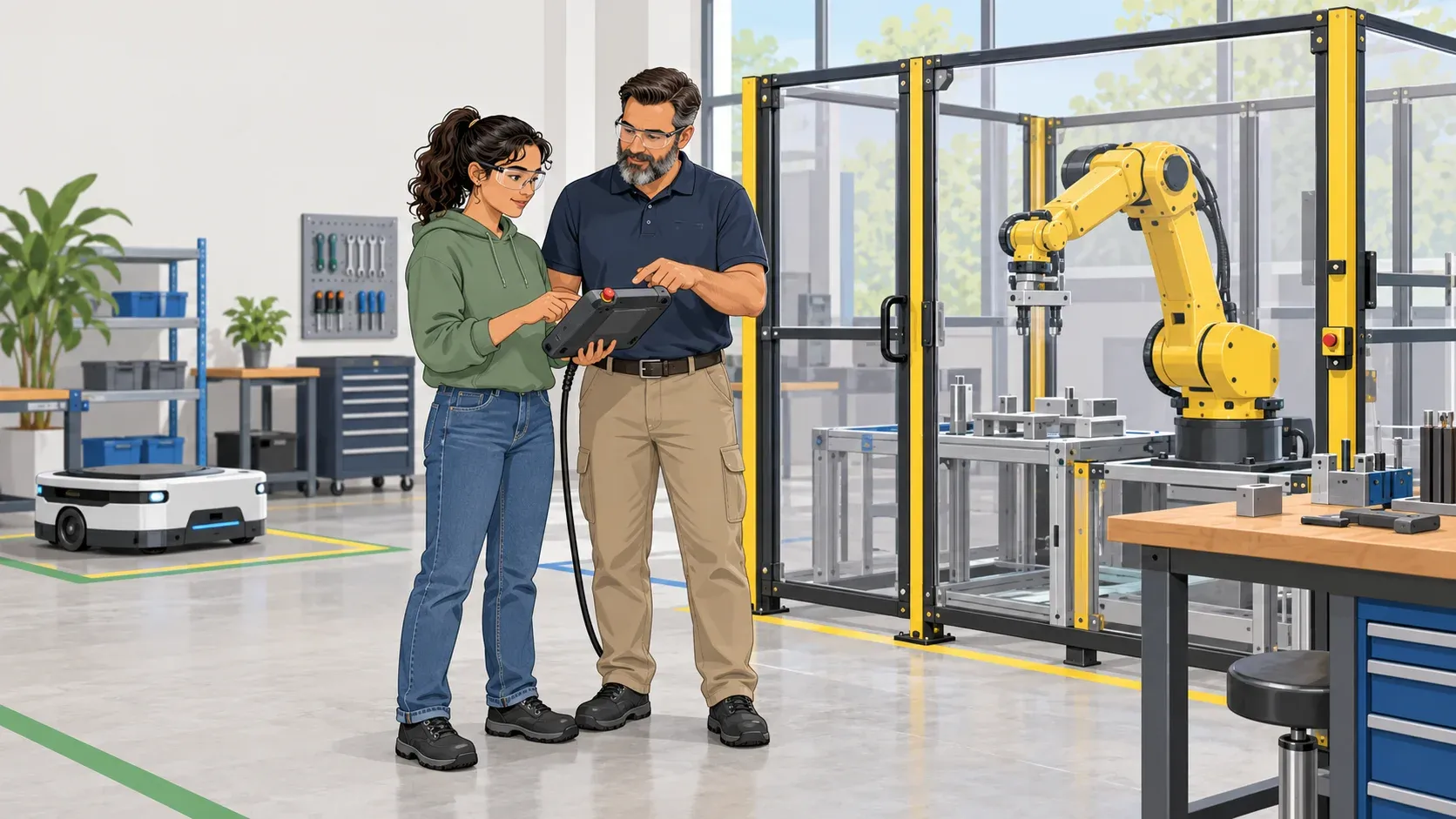

Your student likes machines, coding, or figuring out why something stopped working. Do they need a four-year degree to start working with robots?
Some routes start with paid apprenticeships or trainee jobs. Others expect technical schooling or work experience first. Some require a job with a partner employer. The job title alone won’t tell you the entry rules.
This guide separates three kinds of work. It will not push your family toward a particular path. A listed program is not a promise of a seat or a job.
Choose the work you want to explore
- Keep machines and robot systems running: troubleshoot mechanical parts, electrical systems, and controls.
- Program and connect industrial robots: help set up robot movements and connect the robot to other equipment.
- Service mobile robots: work on robots that move materials around a site.
These jobs overlap. A warehouse maintenance role may include conveyors and motors as well as robots. Not every shift is spent fixing a robot arm.
Maintenance and mechatronics
Mechatronics brings machine parts together with electronics and computer controls. A technician may check a fault message, inspect a sensor, replace a worn part, and record what changed. They work with a team and follow the site’s safety rules. Those rules come first, before work on the equipment.
Check employer and sponsor entry rules
Two employer routes illustrate this work:
- Amazon RME describes paid training and mentored work. RME means Reliability, Maintenance, and Engineering. Its general overview says prior technical experience is not needed, but a reviewed Wilmington job has additional schooling or experience requirements. It also lists an aptitude test, travel or relocation, and varied shifts. Read the exact job, not just the overview.
- C&W Services describes paid instruction and workplace learning with no program tuition charge. Its general rules include age 18 or older, high-school completion or equivalent, and an aptitude assessment. The reviewed Charlton role includes offsite training. It also calls for computer skills and shift flexibility. Confirm the pay unit and travel arrangements with the employer.
Two sponsor routes work differently:
- ROOTS Engineering describes a two-year Florida apprenticeship with no tuition bill. Its rules include age 18 or older, a high-school diploma or GED, English for instruction and safety, and specified physical tasks. An employer can recruit an apprentice or enroll an existing worker. A sponsor contact is not a hiring seat.
- New Century Careers describes two years of classes and employer-site training in southwestern Pennsylvania. Its ARM Institute partner says high-school completion or equivalent is required and prior robotics experience is not. Employer selection still applies. Wages and who pays the employer-tailored fees need confirmation.
Filled / future-cohort example: HARTING through ICATT in Elgin, Illinois lists its positions as filled. The next intake is unknown. ICATT describes one mechatronics apprentice working on robot automation. That does not tell you what every cohort will learn. HARTING’s exact track, length, college partner and pay still need to be confirmed. Use this example to explore the work, not as a current opening.
For a student under 18, ask about age rules before planning around an adult apprenticeship. School-based exploration can help them learn what the work involves, but it is not the same as admission to these programs.
Programming and integration
Robot programming means setting up and testing what a robot does. Integration links the robot to tools and sensors, as well as other machines. The goal is for the whole system to work together. A trainee might help test a movement, track an error, or update work records under supervision. More complex design and fault-finding can come later with experience.
Check the programmer trainee example
GableTek’s Robot Programmer Trainee route in Troy, Michigan welcomes people with no prior experience. It lists high-school completion or equivalent and Microsoft software experience. A certificate or associate degree is preferred. The posting describes no training charge and paid training after starting and between projects. It does not state whether the roughly two-week evaluation is paid.
This is a trainee-job example, not a verified Registered Apprenticeship. The application form does not show how many jobs remain. Ask whether the evaluation is paid and what hours you would work. Also ask when full-time work could begin.
Mobile-robot service
An autonomous mobile robot, or AMR, moves around a site using software and sensors. Service work can involve checking machine parts and finding software faults. It can also mean testing the robot with the site’s team. This differs from programming a fixed robot arm.
Check the mobile-robot trainee example
GableTek’s AMR Technician Trainee route in Auburn Hills, Michigan lists a software background. It prefers a computer-science degree or equivalent. The role also involves travel and all-shifts work. Its entry rules differ from those of the programmer trainee job. Pay and training costs are unpublished, as is the length of training. Do not assume the programmer route’s pay and cost terms apply to AMR work.
These examples cover workplace robots. They do not show a beginner route to opening your own robot-repair shop or working on humanoid robots.
Entry training is not the same as an experienced role
A trainee learns with supervision. With more experience, a technician may handle harder faults, plan maintenance work, or help improve a system. A controls engineer or integration lead may need different schooling and work experience again.
Certificates and associate degrees can help you prepare. Some employers require them; others do not. There is no single no-degree rule for all robotics jobs. An apprenticeship certificate does not replace every employer’s entry rules.
Questions to ask before making plans
- What is the starting pay, and are classroom and evaluation hours paid?
- Who pays for tuition and tools? What about exams, travel, or housing? Is there a repayment agreement?
- Do I need technical coursework, experience, or a partner-employer job first?
- What age and school-completion rules apply to this exact role?
- Which shifts and physical tasks are part of the job? What safety training is included?
- How much travel or relocation is required?
- What credential will I earn, and is there a current hiring seat or training place?
Program registration does not prove that a job is open. Neither does a training description. The profiles below show what was checked and what remains unknown.
One next step: check one route that fits
Choose one reviewed profile below that fits your student’s interests. Check the location and entry rules, too. Read what is still unknown about costs and find the official next step. Then ask the employer or sponsor whether your student can apply now, before making plans.
Sources were checked on October 12, 2026. Training terms and hiring needs can change.