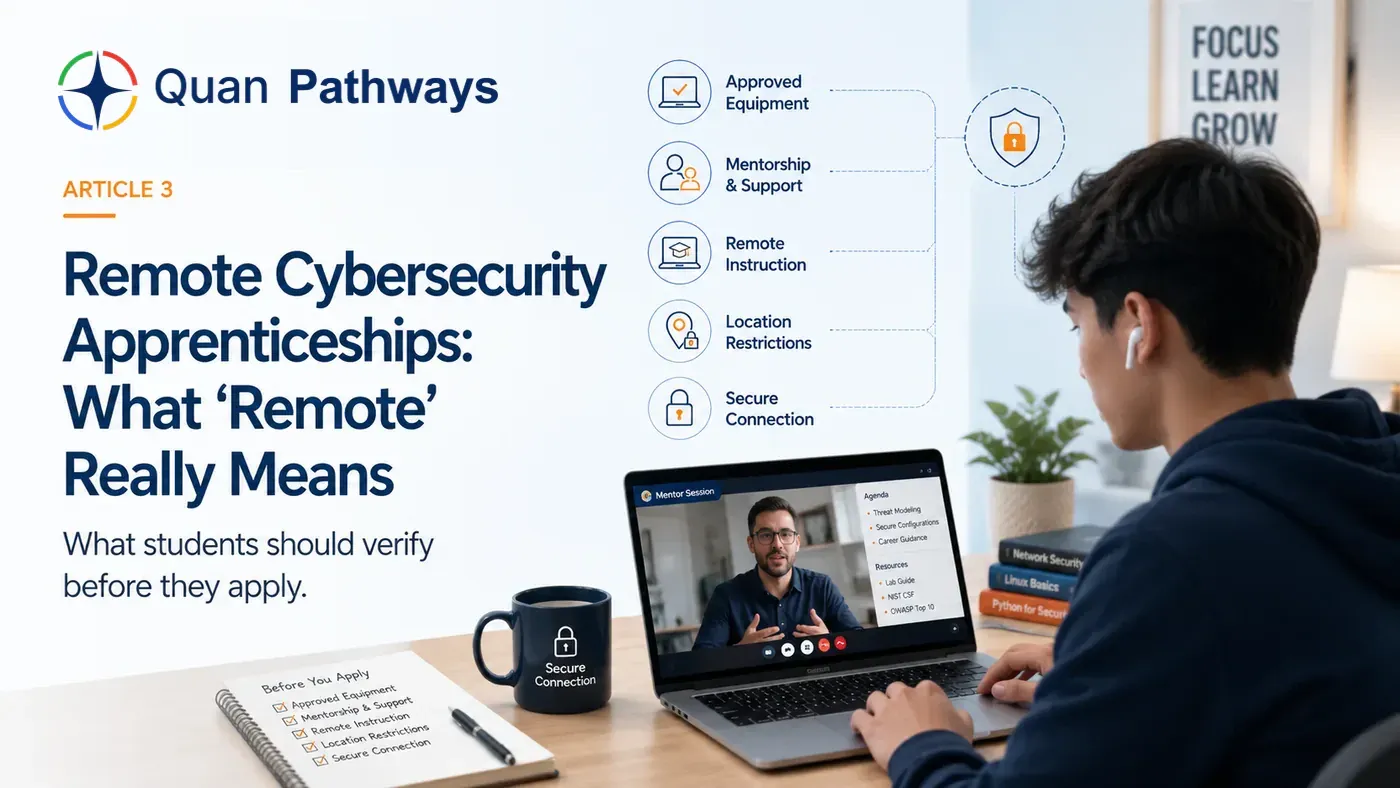
Remote instruction does not necessarily mean a remote paid job. Verify the employer, eligible location, schedule, equipment, in-person requirements, and mentoring before you apply.
Start with three checks
Before you apply, get clear answers to three questions:
- Is there a named employer and a paid job?
- Is the job remote, or only the classwork?
- Which states can you work from? What schedule applies? Who provides the equipment? Are any in-person visits required?
If the sponsor cannot answer these questions, you still do not know what you are applying for.
During my years at Proofpoint, I saw firsthand that meaningful cybersecurity work could be performed remotely.
The threats we dealt with—phishing, malicious links, fraudulent accounts, and social media attacks—did not care whether the person investigating them was sitting in a corporate office.
I could be productive from home.
But there was an important distinction that applicants should understand:
Being capable of working remotely was not the same as having permission to work from anywhere under any conditions.
The employer still controlled the equipment, access to systems, security rules, working hours, and approved locations. Some information could be handled only in certain ways. Team communication still mattered. Employer expectations did not disappear simply because the employee was no longer sitting in the office.
That is why I become cautious whenever I see a cybersecurity apprenticeship described with one simple word:
Remote.
Remote instruction? Remote employment? Remote except for required office visits? Remote only within one state?
The word alone does not answer enough.
A remote apprenticeship has several moving parts
The Department of Labor explains that apprenticeship delivery can include virtual elements of on-the-job training and online instruction. The model is flexible, and the amount of virtual delivery varies by employer and program.
That flexibility can produce very different arrangements.
One program may provide online classes but require the apprentice to report to an employer’s office every day.
Another might offer a hybrid job with two office days each week.
A third might allow the apprentice to work entirely from home but only if the person lives within a particular state.
And sometimes an organization advertises remote training even though no employer has yet agreed to hire the participant.
All of these can appear in a search for “remote cybersecurity apprenticeship.”
Separate the instruction from the job
The first thing I would do is divide the opportunity into three parts.
Where does the instruction take place?
Cybersecurity lessons, certification preparation, and related coursework may be delivered online by a college or training organization.
That tells us where the student learns the classroom material.
It does not tell us where the student works.
Where does the paid employment take place?
This is the key question.
Does the apprentice perform the actual job from home? Is office attendance required several days a week? Are there any required visits for equipment, security checks, training, or team meetings?
A program should be able to explain this clearly.
How does mentoring happen?
Apprenticeship is not supposed to mean watching recorded lessons alone.
A Registered Apprenticeship includes structured on-the-job learning with instruction from an experienced mentor.
In a remote program, the applicant should know how often the mentor is available, how work will be reviewed, and what happens when the apprentice becomes stuck.
“Remote” rarely means “from absolutely anywhere”
An employer might advertise a position as remote while still requiring the worker to live in California, Virginia, or within commuting distance of a particular office.
There can be several practical reasons: payroll registration, state employment laws, customer contracts, equipment delivery, occasional office meetings, or access to government work.
Time zones matter as well.
An apprentice in California might discover that the team begins work at 8 a.m. Eastern time. That is 5 a.m. in California. A student balancing college courses might not be able to accommodate that schedule.
The applicant should not wait until after an offer to ask.
Find out when the employer enters the picture
Some training providers advertise remote apprenticeship pathways because they work with a network of employers.
That can be legitimate, but the sequence matters.
Ask:
- Am I hired before the training begins?
- Is the training provider my employer?
- Will I interview with employers after completing the course?
- Is placement guaranteed?
- What happens if there is no employer opening in my state?
An online training program that may lead to employer interviews is not the same as an open remote apprenticeship job.
Both can have value. They simply should not be presented as though they are identical.
The practical questions applicants should ask
The best questions are usually straightforward.
Is the paid job fully remote?
Do not ask only whether the “program” is remote. Ask specifically about the employment.
Are any in-person visits required?
Ask about equipment pickup, identity or security checks, initial training, recurring meetings, and travel. Do not infer the answer from a remote label.
Who provides the computer?
Cybersecurity work often requires employer-controlled devices, approved software, and specific security settings. An applicant should know whether the employer supplies the equipment and technical support.
What are the working hours?
Remote does not necessarily mean flexible. The apprentice may need to attend live instruction, team meetings, or customer-support shifts.
How often will I meet my mentor?
A specific answer—such as two scheduled meetings each week plus daily team contact—is more reassuring than “reach out whenever you need help.”
Can the remote policy change?
Applicants should understand whether remote work is written into the position or is merely the employer’s current practice.
Remote learning can lose some of the informal moments
My Proofpoint experience showed me how productive remote cybersecurity work can be.
But productivity is not the only goal of an apprenticeship.
An experienced professional already understands how to organize the day, when to escalate a concern, and what an unusual pattern might mean. A new apprentice is still learning those instincts.
Some of that learning happens informally.
A junior employee overhears a conversation. A senior employee notices the junior person struggling and offers help. Someone explains why a seemingly minor detail is actually important.
Those moments have to be recreated deliberately in a remote environment.
NBER Working Paper 31880, a study of software engineers, found that sitting near teammates increased coding feedback by 18.3 percent and improved code quality, with gains concentrated among younger and less-tenured employees. The research was not specifically about cybersecurity apprentices, and it does not prove that remote apprenticeships fail. It does reinforce the need for deliberate feedback and mentoring when beginners are not sitting near experienced coworkers.
People can complete tasks remotely while still missing important opportunities to learn from others.
What a strong remote apprenticeship looks like
Remote does not have to mean isolated.
These are the questions I would use to evaluate a program:
- Is there an identified employer?
- Is the work schedule clear?
- Does the employer provide or approve secure equipment?
- How often does the apprentice have live contact with an experienced mentor?
- Will the apprentice complete real workplace assignments?
- How quickly will the apprentice receive feedback?
- Is there a clear way to ask questions and escalate problems?
- Will the apprentice interact with a team or apprentice group?
- Are performance expectations and wage progression written down?
- Are geographic and travel requirements explicit?
I would also look for signs that apprentices are treated as employees who are learning—not as online students who happen to receive occasional assignments.
The apprentice should know who supervises the work, who evaluates progress, and who can help when something goes wrong.
How we review remote opportunities at Quan Pathways
When we review an opportunity for the Quan Pathways cybersecurity directory, a delivery label is only a starting point. It is not a guarantee that every remote detail has been verified.
Families should ask the employer or sponsor to confirm:
- Is only the instruction remote, or is the paid employment remote too?
- Is the job fully remote or hybrid?
- Are visits for onboarding, equipment, training, or meetings required?
- Which states or regions are eligible?
- Has an employer placement been confirmed?
- If placement is pending, what exactly must happen before employment begins?
Those answers can completely change whether a student should apply. Our profiles make unresolved details visible when the official sources do not answer them. For examples, review the current notes for iQ4, ECPI, and Trusted Internet, then reconfirm the terms with the employer or sponsor.
Remote cybersecurity apprenticeships can open doors for people who live far from major employers, lack transportation, or need greater flexibility.
They can be excellent opportunities.
But the word “remote” should not be allowed to hide the most important facts: who is employing the apprentice, where the work happens, and whether a new worker will receive the mentoring needed to build a career.
From my own experience, remote cybersecurity work can be both productive and meaningful.
The question for an apprentice is not simply:
Can this job be done from home?
The better question is:
Has this program created a remote environment in which a beginner can genuinely learn, contribute, and grow?
Research reviewed August 2, 2026. Remote-work, residency, equipment, and travel requirements should be confirmed directly with the employer. Send us a correction.