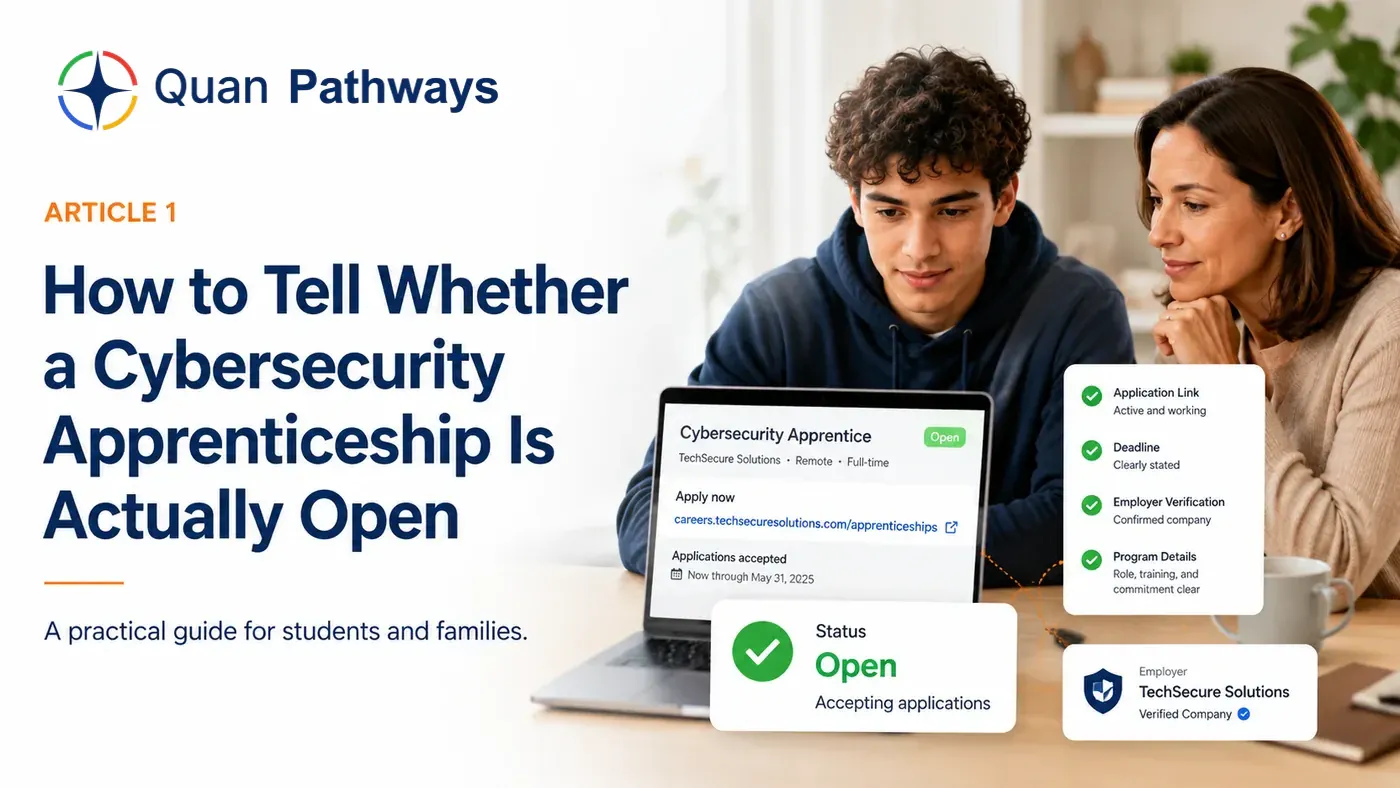
A registered program can be real without accepting applications today. Before investing time, confirm a current employer opening, deadline, eligibility, location, and working application.
When I began looking for cybersecurity opportunities for younger members of my family, I assumed my technology background would make the search fairly straightforward.
I had spent decades in technology and nearly six years working in cybersecurity at Proofpoint. I understood the terminology. I knew how employers organize job postings and how websites sometimes fall out of date.
Even so, I kept running into the same frustrating problem.
I would find what looked like a promising cybersecurity apprenticeship. The program had a professional website. It described the training, the benefits, and sometimes even the experiences of previous apprentices.
But after following several links, I would discover that applications had already closed—or there was no application at all.
That experience led me to an important distinction:
A cybersecurity apprenticeship can be completely real without being open today.
For a student or parent, that difference matters far more than whether the program once existed.
Why families are searching for these opportunities
Cybersecurity deserves the attention it is receiving.
The Bureau of Labor Statistics expects employment for information security analysts to grow 29 percent between 2024 and 2034, with approximately 16,000 openings projected each year. The reported median annual wage was $124,910 in 2024, although an apprentice or entry-level worker will naturally begin far below that figure.
Registered Apprenticeship is also becoming a meaningful pathway into technology. The opportunity is real.
Unfortunately, a Google search result does not tell a family whether a particular employer is hiring right now.
A program is not the same as an opening
A Registered Apprenticeship has a specific meaning. It combines a paid job with structured workplace learning, instruction, mentoring, progressive wage increases, and a nationally recognized credential. The program is approved by the Department of Labor or an authorized State Apprenticeship Agency.
That structure is valuable, but it answers only one question:
Is this a legitimate apprenticeship program?
The applicant still needs answers to several others:
- Is a new group being recruited?
- Which employer is hiring?
- Is there a working application?
- Does the applicant qualify?
- When does the job begin?
An organization might operate a legitimate Registered Apprenticeship but recruit only once a year. A training provider might prepare people for apprenticeships without employing them. A successful former cohort might still appear online long after recruitment ended.
All of these pages can look like open opportunities.
The process I now use
I no longer treat an apprenticeship as open until I can follow it all the way to an actual employer or program application.
Here is how I check.
First, find the employer
When reading the program page, I look for concrete hiring language:
- “You will be employed by…”
- “The participating employer is…”
- “Apply for the apprentice position…”
- “Starting wage…”
Sometimes the organization promoting the opportunity is a college, workforce agency, nonprofit organization, or training provider. It may play an important role, but it may not be the organization issuing the paycheck.
When the page refers vaguely to “our employer partners,” I keep digging.
Who is hiring? When will applicants meet the employer? Is employment provided when someone enters the program, or do participants compete for a placement later?
Those are very different arrangements.
Next, test the application
A large “Learn More” button is not necessarily an application.
I follow every link until I reach one of three places:
- The employer’s career system
- An official government hiring portal
- A clearly identified application managed by the apprenticeship sponsor
A newsletter signup, talent community, or “express your interest” form may be useful for future announcements, but it is not the same as applying for a current job.
The federal Apprenticeship Job Finder is an important starting point, but it pulls listings from multiple sources. Apprenticeship.gov explains that search results can come from RAPIDS, the National Labor Exchange, state job banks, and other job boards, and that applicants are sent to the employer’s application or point of contact.
That final employer page is the one I trust most.
Then, look for dates
This is where many promising searches fall apart.
A page may describe a “summer cohort” without saying which summer. A press release may announce a program that launched two years ago. A success story may celebrate former apprentices without mentioning when the next group will be recruited.
I look for a current deadline, a starting date, or clear language such as:
Applications are now being accepted for the January 2027 cohort.
When there is no year or current recruiting statement, I do not assume the opportunity is open.
Confirm that it is actually paid employment
The word “apprenticeship” is sometimes used loosely.
A Registered Apprenticeship is a paid job. The apprentice receives workplace training under a mentor, related instruction, and progressive wage increases.
That is not the same as:
- A cybersecurity boot camp
- A certificate course
- An unpaid training program
- A pre-apprenticeship
- An internship
- A program that may refer participants to employers later
Some of those alternatives may still be excellent. They simply need to be described honestly.
Before a family commits time or money, it should know when wages begin, who employs the participant, and whether completing the training guarantees a job or only creates a chance to interview.
Finally, check whether the student qualifies
An apprenticeship can be open and still be unavailable to a particular applicant.
Programs may be restricted by age, state, commuting distance, school enrollment, graduation date, work authorization, previous experience, or the ability to work a full-time schedule.
Cybersecurity positions connected to government work may also have citizenship or security requirements.
Even the word “remote” can be misleading. The classes might be online while the paid job takes place in an office.
Sometimes the best next step is a simple email
When a page remains unclear, I would not send a seven-question interrogation. I would start with a short, natural message:
Hi, I recently found your cybersecurity apprenticeship and am very interested in applying. Are you currently accepting applications for the next group? If so, could you point me to the employer’s application page? Thank you.
That answer usually tells you whether it is worth asking about wages, location, and other details.
If no one responds, the program may still be legitimate. But I would describe its current status as unverified rather than open.
Even respected sources become outdated
This problem is not limited to questionable websites.
NIST once maintained a Cybersecurity Apprenticeship Program Finder. In June 2026, NIST updated the page to explain that it no longer maintains the finder and now directs visitors to ApprenticeshipUSA for current listings.
That was the responsible thing to do. NIST did not leave people guessing about whether its directory remained current.
It also shows why every apprenticeship listing needs a visible verification date.
How we are handling this at Quan Pathways
At Quan Pathways, we do not want to create one enormous list that forces families to investigate every entry for themselves.
Our reviewed cybersecurity directory uses the availability model families see on the live profiles:
- Open: We found a current applicant action and reviewed the evidence supporting it.
- Seasonal: Recruiting follows a recurring cycle, but applications are not continuously open.
- Temporarily closed: The program has paused intake or is not accepting applications at this time.
- Closed: The reviewed opportunity or application period has ended.
- Unverified: The program may exist, but we could not confirm a current opening.
Each profile also shows what we could verify about the employer or sponsor, applicant action, location, compensation, eligibility, and review date. A label is not a promise: families should still reconfirm the details before making a decision.
For examples of how those distinctions appear in practice, compare the profiles for Each1Teach1 Tech, Franklin University, and Aspiritech Academy.
Artificial intelligence can find hundreds of program pages very quickly. It can summarize their descriptions and organize the information.
What it usually cannot know without current human verification is whether an employer removed its application yesterday, changed its geographic restrictions, or quietly delayed the next cohort.
Families do not need the longest possible list.
They need an honest answer to a much simpler question:
Can my student apply for this opportunity now—and what should we do next?
Research reviewed August 2, 2026. Recruiting dates and eligibility requirements should always be reconfirmed with the employer or program sponsor. Send us a correction.